Stat counter


View My Stats

Thursday, 31 May 2012

Kernel

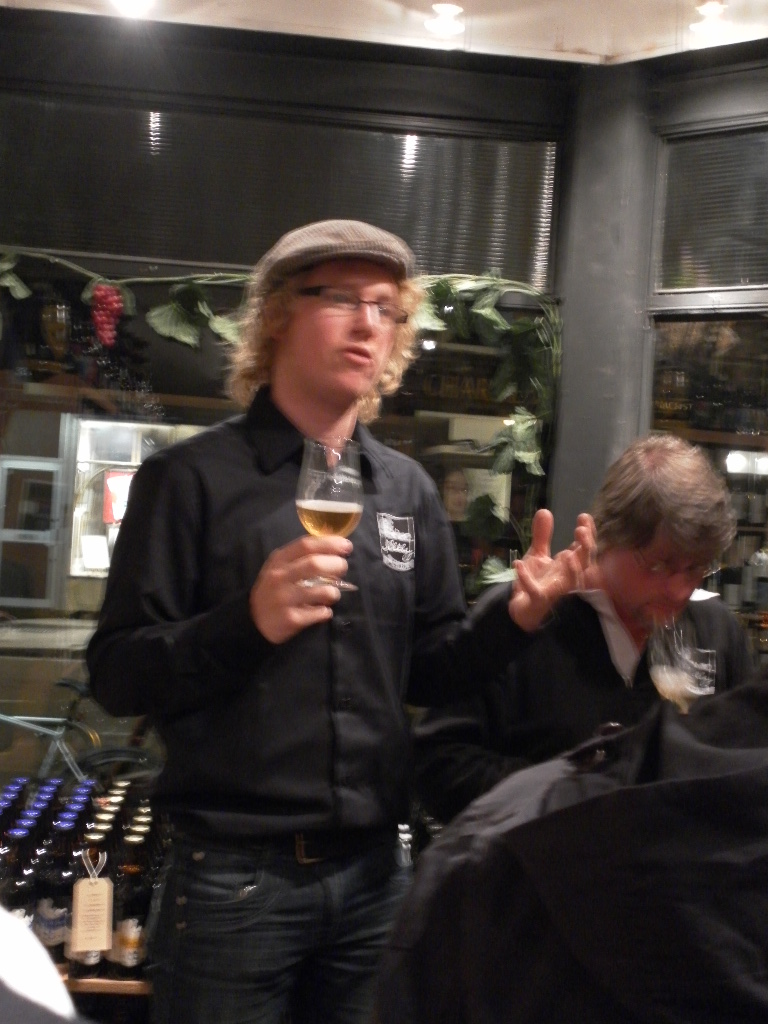
If you like hops (which I do) what better way to spend an evening than quaffing your way through some of the finest offerings of the Kernel Brewery.  Still small enough to get away with never producing the same beer twice, their pursuit of punchy but balanced flavours is responsible for some of the best beer coming out of microbreweries today.  Having just relocated slightly east from their old brewery near Borough market into a brewery with five times the capacity in Bermondsey, I hope to see more of it around in future.  We were lucky enough to try some of the first brews from the new kit.  


There is something quite magical about heavily dry hopped beer barely a few weeks old.  Their pale ales are brewed with a simple malt and yeast base, allowing the hop character to dominate.  Dry hopped to within a sniff of perfection creates a delicate but powerful aroma, extracting all the fruity flavours without the bitterness from the hops.  We tried a couple of single variety hop pale ales - Nugget had a fresh lemongrass character and Nelson Sauvin the classic grapefruit and gooseberry notes that make it such a popular hop at the moment.  But the star of the show was the IPA SCCANS - the latter standing for the five hops it contains - Simco, Centennial, Citra, Apollo and Nelson Sauvin.  I could drink this beautifully balanced, intensely fruity, slightly hazy beer all night (probably not a daytime drink at 6.9%).  The precise mix in their multi-hopped IPA is a moveable feast, subject to what is, quite literally, 'flavour of the month' with the brewers.  I look forward to trying the next pick 'n' mix.

  
We then moved on to some of the darker beers.  Their IPA Black V is probably the finest example of a "black IPA" I've ever had.  According to Toby, if you tasted it blind you would think it was a normal IPA.  Quite some claim, and almost accurate.  It certainly smells just like an IPA, and the first taste is full of tropical fruits with a hint of pine.  But the slightest tell tale on the follow through is just a hint of chocolate.  I will however allow the claim as it's such a beautiful beer.

The Export India Porter had a huge coffee nose and bitter coffee palate, but the dry hops still came through. And the Export Stout was full of burnt toast body.  But these were probably wasted on a Fuggles who was still floating on a cloud of dry hops  from the Pale Ales and India Pale Ales.  And I think that's where I'd like to be left, for some time...

Sunday, 20 May 2012

EBBC12 in pictures, because I am lost for words

In some ways I could probably reflect that EBBC12 was not the most successful for Fuggles.  Unforeseen circumstances meant I could only attend the Friday, and I was particularly sad to miss the spectacle that is live beer blogging (or live taking notes and writing them up later, if you have not yet joined the i-generation like me).

Being a technophobe is a disadvantage for a blogger in many ways.  Trying to juggle beer, camera, notepad and pen with only two hands simply doesn't work.  This is probably why Steve Jobs wrapped the latter three into one.  If he'd managed to achieve all four, even Fuggles might own an apple product.  The result of my juggling conundrum, you will see below, is alot of photos and lamentably few notes from which to write now.

But to call it unsuccessful would deny justice to the brilliant day that Friday was, and above all the fabulous people that made it so.


First mention must go Williams Brothers, with their unfailingly brilliant selection of beers, not to mention quite remarkable tolerance of my cheek on Friday (thank you Chris).  I was particularly in love with the Double Joker IPA, the Hollaig and the Fraoch.  But I've not had a Williams beer I didn't like yet.

Special mention too must go to the Badger girls and their pairing of beer with cheese.  Quite the most spectacular truckle of cheddar I have ever seen and damn tasty with the poacher too.  I was unconvinced by the Dorset knobs, I hope you'll forgive me.
Marstons hop display (before I scattered them all over the table) was also great for sniffing, comparing the single hop beers, and generally picking your favourite.
To Molson Coors and Stuart Howe for the beers and commentary with dinner.  But particularly to my fellow diners for their fabulous company and for tolerating my chat and pouring, both of dubious quality by this stage.
Did I mention I'd like to thank Chris from Williams Brothers?  Alot.

And thank you to all the lovely lovely people there on Friday who are the reason I go to things like this, and the reason I write about beer.  The passion of people for the drink and the industry creates an atmosphere unlike any other.

I was very sorry to miss you all on Saturday.  Twitter is no substitute!

Thursday, 29 March 2012

Ilkley @realale.com

It had been far too long since Fuggles had paid a visit to the lovely folks at realale.com, so whilst it seemed a shame to pass by the bustling banks of the Thames on an unseasonably warm March evening, I was very much looking forward to an evening with the Ilkley brewery.

<> 
<><>
<>


Previously familiar with the award winning Mary Jane and Lotus IPA, I was keen try some of their lesser seen beers, and meet one of the men behind it.  Only brewing since 2009, these two beers have really catapulted Ilkley into the limelight.

If you haven't tried them, keep an eagle eye open.  Mary Jane is a staggeringly tasty beer for 3.5%, owing to a good dose of Amarillo hops, which impart great citrus character, but in a well balanced way.

The Lotus notches up the stakes in strength, hop character and fruity esters.  The tropical aroma hits you in the nose straight away, rich and warming mango drawing you in.  The first taste is a hit of richness, which gaves way to a lighter finish before the bitter follow through.  A great example of an IPA.

Ilkley Gold was a fruity floral session beer of 3.9%, delicately hopped and very drinkable.  Ilkley Pale was very dry pale ale, so pale it was almost green in appearance.  The Nelson Sauvin hops impart a classic grassy character with hints of Elderflower, so reminiscent of a Marlborough Sauvignon Blanc.


But the revelation of the night for me was the Ilkley Best.  The use of burnt malt makes for a very full bodied bitter, before the spice of the Brewers Gold hops kick in.  This was a really fiesty bitter that left your tongue positivley tingling.  The burnt malt was used again in Ilkley Black, just peppering slightly the smooth Mild with hints of liquorice.

Some really nice examples of what you can do with bold ingredients to reinvigorate classic beer styles, these brewers have good paletes and the beers are highly worth a dabble if come across them.


Thursday, 19 January 2012

Camden Town @ Draft House Tower Bridge

Does unfiltered beer give you hangovers?  Always keen to test a theorem and highly optimistic for the null hypothesis Fuggles merrily quaffed away tonight courtesy of Charlie Mcveigh of Draft House, Jasper and the team from Camden Town Brewery and Justin Carter (who kindly got me in the door at the last minute).

I'm a huge fan of what Camden Town are doing.  An artisan twist on traditional beer styles - contemporary, with being try-too-hard.  I'm mostly in love with everything I tried tonight.  Being in much polite company I can't supply you with photos, so please open your imagination instead and enjoy the below.  Or better still, seek them out for yourself in the soon to be opened brewery tap at Camden.

We opened with the Gentleman's Wit - a lemon and bergamot wheat beer where the lemons are roasted to release the oils.  This pale almond cloudy liquid was fresh, zesty and immensely drinkable.  Definitely the session beer of the night.  The Hells had been matured for 6 weeks in tank at Camden town, and 6 hours later, pretty much decanted into our glasses.  A proper kellarbier with spicy floral notes that remind me so much of heather honey.

Then onto the bottled wheat beer, a heffe weisser, brewed using traditional german yeast and very few hops.  There is an interesting story behind the yeast, which Jasper tells far better than I would ever attempt to, but the character of the yeast is the embodiment of the beer.  A variety of malted barleys balance the wheat to create a darker, sweeter and very quaffable variant of wheat beer.

And finally onto the hoptastic finale.  I'm not sure we were ever told how many IBUs were in this beer, but alot.  However, this chestnut coloured IPA had a richness that complemented and toned down the strident bitterness of the (9?) hops and resulted in a full and satisfying IPA.

Mention also should go to the chef, for the quite awesome foot long pork scratchings and even better pork belly.  Fuggles is all at once quite satiated with good beer, food and company and will be visitng draft house again very soon.

Sunday, 15 January 2012

A Lambic Odyssey

It's been a while, I know, but after a brief hibernation Fuggles has rejoined the world of the wide web.  I blame Christmas myself, and I don't mean that in a bad way.  Research commissioned by the cask report in 2011 suggests that cask ale drinkers are more naturally adventurous in what they drink, and consequently less likely to stick to one category of drink.  In December, for me, this comes in the form of mulled wine.  But if it weren't for this fact, I might not be about to extol the virtues of the unusual Lambic beer from Belgium. 

Ever since a tip off from Mark Dredge I've been meaning to check out the Cantillon brewery in Brussels.  Cantillon has been brewing Lambic beer in Brussels in the traditional way for over a hundred years and is the last brewery still running in the capital, under the auspices of the same family which founded it.  The knowledge and skill passed down through the generations is as important a part of the beer as the very fabric of the brewery in which it is made.

Many beers describe themselves as Lambic.  Most that reach the export market have been sweetened to increase the appeal and popularity.  Classic examples being Lindemans and Mort Subite.  The purest and most traditional form of lambic has virtually no sugar in at all (having been entirely consumed by the yeast) and is incredibly tart and sour - a definite acquired taste.  Unlike most beers, old hops are deliberately used to avoid imparting any flavour, and solely for their preservative properties.  Lambic is perceived by some to more closely resemble cider than beer.


What makes Lambic beer so special is the yeast.  Most breweries preserve a pure strain of their yeast in an off site yeast bank, to allow generation of new yeast for fermentation and a consistent brew every time.  Lambic beer is produced using wild yeast.  Samples of Cantillon beer have revealed over 60 different strains of yeast in a single bottle.  The production of lambic beer is therefore unlike any other. 
The cooling tank (above) is where the magic happens.  This large flat vessel is where the near boiling wort is pumped to for cooling.  Boiling has at this point destroyed any organisms that may have been present in the beer thus far.  The sterile liquid is now exposed to the air overnight whilst it cools.

The brewery must therefore ensure a good "infection" of the wort.  There are holes in the roof to encourage circulation of air.  The wood from which the brewery is built is the natural breeding ground for the yeast.  If repairs need to be undertaken to the brewery, only a small amount of wood can be removed at a time to ensure this unique "yeast bank" is not depleted.  Furthermore, brewing can only take place in the winter months to ensure that the wort cools to a level where the wild yeast can survive but bacteria (that would spoil the beer) cannot - around -5 to +5 oC.

 
The beer is then left to mature in barrels for anywhere from 14 months to 3 and a half years.  From this base a number of beers can be created.  The skill in lambic beer production lies not just in a good brew, but in a good blend.  "Geuze" beer is produced by blending old and young lambic to create secondary fermentation in the bottle, which adds carbonation to the beer.  This blending is the skilful part of making a geuze and the "head brewer" describes himself instead the "master blender" in reflection of this.  Because each bottle of beer is different (due to the effects of the wild yeast) this can only be done by tasting and blending.
Alternatively, fruits are added to provide the sugar for secondary fermentation.  Classic beers are Kriek (sour cherries) and Framboise (rasberries).  The Cantillon fruit lambics have an intense nose and first hit of fruit when you taste it, with the sourness of the lambic sweeping in to finish.
Our favourites were the Fou Foune (apricot) and Zwanze 2011.  Zwanze is the annual limited edition brew.  Cantillon are not afraid to experiment with mixing grain and grape and have several regular examples of this.  Zwanze 2011 contained a peppery grape variety called Pineau d'Aunis which provides a great contrast to the underlying sourness of the lambic.
You can only get this beer in the brewery itself, so if you want to try some you'll have to get over there (which I thoroughly recommend anyway).  Be warned though, our guide recommended a 1-2-3 approach to drinking the beer.  Essentially it takes 3 sips to get used to the flavour before you can start to enjoy it.  Some would argue more, but this is a beer that will not be to everyone's taste.

It's no secret that I like my Belgian beer, but I cannot stress enough that the Cantillon brewery offers a rare (but very accessible) opportunity to learn about and try something unique.  If you're ever in Brussels do pay it a visit.  Even if you can't get your tastebuds round the style it's a living part of Belgium's brewing history.

Postscript
Much can (and has been) written about Belgian beers and bars, which I won't attempt to better.  If you're planning a visit I recommend a read of the beer advocate.  Instead, I'll just leave you with some abbreviated highlights.

LATE NIGHT BEERS: Delirium Taphouse (excellent selection, didn't ever seem to close, also 400 vodkas if you're that way inclined)
LENGTH OF BEER LIST: Porte Noire (a warm dark cellar with an overflowing fridge and never ending beer list)
LOCALS' BEER CAFE: Le Coq (choice completely uninfluenced by childish humour)


GEUZE: Cantillon (obviously), Tilquin, Oud Beersel
LAMBIC: Bon Voeux 1 An
BRUNE: Bourgogne des Flandres Brunes
KRIEK: Kasteel Red
TRIPEL: Karmeliet, Caulier


Thursday, 27 October 2011

Mikkeller @ Cask

Fuggles was very excited last Saturday, almost beside myself with excitement.  I couldn't quite believe that Cask Pub & Kitchen were playing host to my brewing hero - the legend that is Mikkeller.  It was clearly a sentiment shared by most others in the pub, judging by the respectful silence that hung in the air while he spoke.  It is rare to see Mikkeller on tap in the UK, although most good specialist beer pubs will have a selection of bottles.  You certainly won't see 12 Mikkeller beers on one bar again in a hurry.


Mikkel himself is an unassuming and modest type, whose mission in brewing is to keep making better beer, always push the boundaries and try something unusual - an ambition that's hard to fault.  What is perhaps most amazing about his modus operandi is that rather than run his own brewery, he 'rents' other people's breweries to produce his stuff of magic.  This may mean that no two beers are ever quite the same, but after all he doesn't exist to keep churning out the same beer year after year.  Although it seems this spark of genius may be borne less of creativity or financial acumen and more of pragmatism, Mikkel professing to a particular dislike of cleaning his equipment. 


What was particularly special about this meet the brewer event was the amazing atmosphere.  It was more like being at a house party (but with better booze).  Random conversations easily struck up with people at the bar, or the next table along.  The sense of excitement in this shared experience, and obviously a proliferation of opinions on the beers providing an easy common denominator.
So onto the beer.  I could list them all as great beers, but I'm not here to regurgitate a beer menu to you, so I'll just note my top picks.  Faced with the dazzling menu, and realising we couldn't drink it all presented some tough conundrums.  It should be noted that the inevitability of trying to drink them all hadn't even occurred to us, we were still quite sensible at this stage.


An early crowd pleaser was the "Nelson Sauvignon" (pictured at the top with "A Pale Ale").  Apparently one of Mikkel's own favourite beers.  A beer of high acidity, but still fruity, vaguely reminiscent of caramelised pineapple.

The "Double Shit Coffee" (or VB Kaffestout) was a beer to rival Dark Star's Espresso.  Rich chocolate notes on first tasting give way to a fuller bitterness, like chewing on roasted coffee beans.  A truly wonderful stout.

The "Black Hole"s matured in a variety of barrels were also tasty.  Our favourite was the Tequila, as it cut through the stout and lifted it, leaving a slight hint of Tequila at the end.


 And finally we come to what may have been our undoing.  But was probably just the straw that broke the camel's back (having worked our way up to it through the rest of the menu).  The "Black 2011" weighing in at an almighty 17.5% was just too tempting to resist.  I've had strong beers before that had little to say for themselves apart from their strength, but this was stunning.  Rich, meliflous and terribly naughty.  According to the Beer Gremlin, if they served beer in a den of iniquity (which I'm sure they would?), this would be it.

It was great to meet the man behind the beer, and sample so much of his repetoir side by side.  Whilst I am eternally grateful to Cask for playing host to my brewing hero, I would just make a small plea that you start serving his beer in thirds...

Wednesday, 19 October 2011

Beer and Food Matching

Whether you're a regular experimenter with beer and food, have the odd dabble, or never tried it before, I really cannot recommend highly enough an event put on by beer professionals to learn something new.  That said, there's something equally satisfying about having a go yourself next time you're in a great cask or speciality beer pub.  Try something new, something you think won't work, it just might.  In this vein of adventure, off trotted Fuggles to South West London.


Billed as Battle of the Sexes.  John Keeling vs Melissa Cole.  (Or Fuller's beers vs non-Fuller's beers).  Six courses, each with 2 beers matched with it - one selected by Ms Cole, the other by JK, you judge and jury - which works best? It sounded like a gastronomic delight going down at the Red Lion in Barnes on 14th October.  And that was before we discovered that one of the "courses" contained 4 different charcuterie, each of which was matched with 2 different beers.  Those warm up drinks suddenly started to feel like a bad idea.

To start was a test of the time honoured matching of porter and oysters.  I must confess to never having tried this before - remaining in the curious but unconvinced pool of people.  Fuller's London Porter squaring up in this instance to Aspall's Premier Cru.  A lovely cider (or should I say cyder?) in normal circumstances, but in this case I found it wholly too acid for the oysters, and the warm comforting blanket of the London Porter coated the Oysters in a surprisingly silky way on the palette for me.  1-0 to John.


Onto "Course" 2 (part 1) - smoked duck breast with cherry compote.  Anchor Liberty vs Fuller's Chiswick.  I'm a massive fan of Anchor beers (see Beer Fest in a box for one of my favourites).  But when it came to pairing with the sweet and smoky duck the Anchor was entirely too powerful for the food, and the mellower Chiswick won out.

(Part 2) - air dried ham and fig.  Honeydew vs Harviestoun Bitter and Twisted.  Again, I found the Bitter and Twisted just a little overpowering for the dish, whereas the Honeydew pulled out the sweetness of the fig and exploited nicely that classic sweet and salty combination that is so moreish.


(Part 3) - salt cod brandade on ryebread.  St Austells Clouded Yellow vs Fuller's Discovery.  Melissa had it for me here.  Clouded Yellow is a great beer, but the real secret lay in the thin layer of horseradish between the brandade and the bread.  The spicy notes from the coriander in the Clouded Yellow teased this out perfectly, allowing the spicy flavour to linger on the tongue.

(Part 4) - Devils on Horseback - Chimay Blue vs HSB.  This was almost too close to call.  So I won't.


Main 1 - Yam Fatt Putt.  OK, I'll explain it.  Chinese style pork belly with sweet potatoes in a big yam doghnut.  Fuller's Past Masters Strong Ale vs Thornbridge Kipling.  Much as I love Thornbridge, it was way too hoppy for the sweet plum sauce of the pork belly.  Past Masters XX had it for me by a country mile.  Rich, sweet and mellow, I'd never have thought of pairing it with anything but a sharp cheese, but it surprised me by not being cloying with the sauce.  Nice pick JK.

Main 2 - Lahmacun (AKA spicy lamb pizza - sort of) - Fuller's London Pride vs Williams Bros Grozet.  For me the intensely herbal Grozet - the stuff that Williams Bros do best - was a clear winner here.  London Pride is a great session beer, but it didn't add to the food, didn't detract from it.  It just didn't interact.  One more to Melissa.

Dessert - Pear Tart Tatin with Fuller's Double Stout Ice Cream.  Dark Star Espresso against (you guessed it) Fuller's Past Masters Double Stout.  I love the double stout, it's a quirky stout, with some aniseedy notes, and really does the style credit.  But the espresso here with its intense coffee flavour and greater sweetness, almost like a tia maria, just toned in nicely with the dessert.  I think we're about 4 - 3 to JK now.


Digsetif - Chilli salted Caramel Tart - I loved this course, sweet, salty, spicy, so hard to match!  You need a BIG beer to deal with that, let alone add to it.  In the red corner, Fuller's Golden Pride, in the blue corner, O' Hanlons Brewers Reserve.  It could only be the bigger beer that won out in this heavyweight competition.  In this case it was the fruity, mellow, marmalade mitts of Golden Pride wrestling the chili caramel down your throat.

So 3 hours later, satiated in the extreme, I left the night reminded of three things.  Firstly that matching beer with food can be equally, if not more powerful than matching wine with it.  Although on the flip side it can also miss the beat entirely, which I find happens less with wine.  Secondly that Fuller's has a staggering range of beers.  We tasted less than half their range, and no two were even a similar style.  And thirdly and most importantly that experimentation is always a good thing, and life can only be the richer for it.

Many thanks to the staff of the Red Lion for the exquisite food, and Melissa and John for their careful pairings and tutelage on the night.